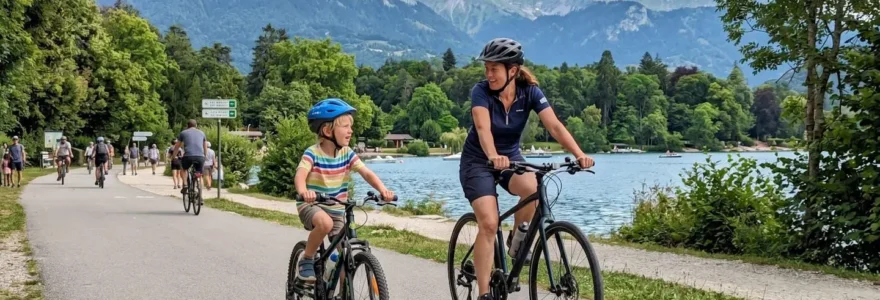
The 42-kilometre circuit encircling Lake Annecy has evolved from a local leisure route into one of Europe’s most frequented family cycling destinations, attracting international visitors seeking accessible Alpine scenery without the gradient punishment of mountain passes. Yet accessibility remains a relative term requiring context — what proves effortless for regular weekend cyclists may challenge families with young children or seniors unaccustomed to sustained physical activity.
Understanding whether this route genuinely suits your specific group demands moving beyond marketing promises to examine concrete infrastructure details, realistic completion times, and the equipment choices that transform feasibility. The answers depend less on abstract fitness levels than on matching route characteristics to your group’s composition and expectations.
Your priorities before booking bikes:
- The majority of the route follows dedicated, car-free greenway with a smooth paved surface
- Terrain remains predominantly flat with one gentle climb near Talloires
- Children aged eight and above typically manage on their own bikes; younger riders thrive in trailers
- Electric assistance transforms the experience for seniors and less confident cyclists
- Realistic completion time spans three to six hours depending on fitness level and break frequency
The infrastructure reality: what the 42km route actually offers
Raw numbers tell part of the story. According to infrastructure data published by SILA, the public authority managing the western shore, the dedicated Voie Verte greenway spans 33 kilometres of purpose-built cycling infrastructure. This section features a 3.5-metre-wide paved surface, completely separated from motor traffic, with three underground passages eliminating hazardous road crossings. The remaining segments share quiet local roads through lakeside villages where vehicle speeds drop to residential levels.
That technical specification translates into something families notice immediately: children can ride two abreast while chatting, mobility-impaired cyclists navigate confidently, and the primary safety concern shifts from traffic vigilance to avoiding collisions with slower-moving pedestrians during peak summer weekends. The surface quality matters enormously for nervous riders — the national framework for cycle tourism established by France’s Ministry of Economy identifies smooth, well-maintained surfaces as the critical factor determining whether 22 million French holiday cyclists actually complete their intended routes.
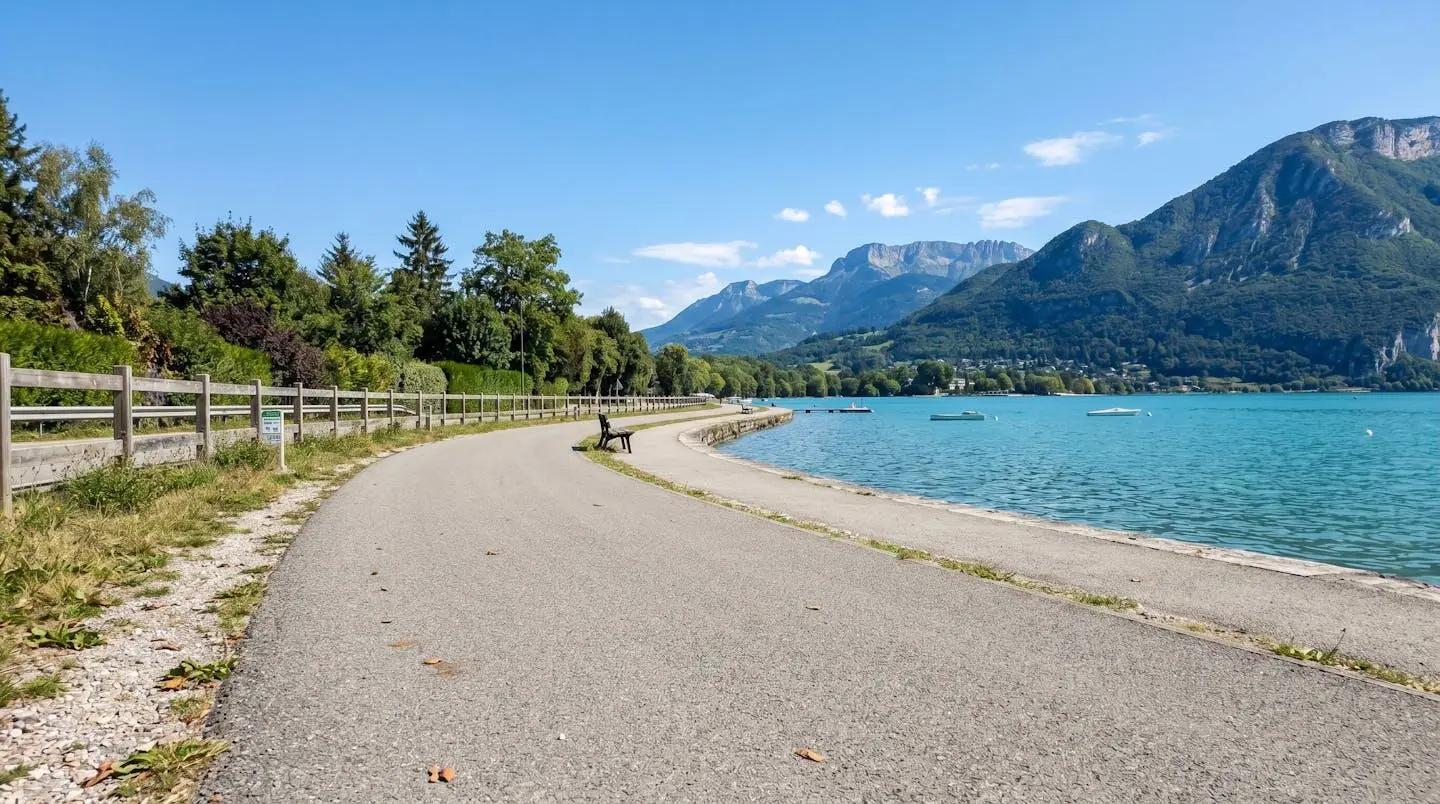
The gradient profile distinguishes genuinely accessible routes from those merely marketed as such. The eastern shore between Saint-Jorioz and Doussard features gentle undulations, with the most noticeable climb near Talloires representing a manageable gradient for most riders. The circuit avoids the punishing Alpine ascents that characterise the surrounding road network, though « flat » remains relative — riders accustomed to the Netherlands’ pancake-flat polders will notice the difference, whilst those familiar with family-friendly cycling routes for kids across Europe will recognise terrain similar to easier sections of the Loire valley routes.
The infrastructure’s success manifests in measurable usage patterns. Peak summer demand demonstrates both the route’s appeal and the practical challenge of timing your ride to avoid the busiest periods.
10,000passages/day
Peak daily frequency on Lake Annecy’s Voie Verte during summer season
Those numbers carry implications. High summer weekends see the greenway function almost like a slow-moving cycling motorway, where families benefit from the collective safety of volume but must navigate a constant stream of faster riders overtaking. Weekday mornings outside French school holidays offer a markedly different experience — the same infrastructure, half the stress.
How different rider types experience the Lake Annecy loop
The calculus shifts entirely when young legs tire unpredictably. A British family arriving with two children aged seven and ten faces a legitimate question: will enthusiasm last beyond the first scenic viewpoint, or will the return journey deteriorate into complaints and fatigue tears? Real-world completion patterns suggest that equipment choice and pacing strategy matter far more than children’s baseline fitness. Rental services like mobilboard.com provide child seats, trailers, and tag-along attachments as standard equipment precisely because these options transform feasibility. Electric bikes for adults create the capacity to tow tired children without the adults themselves becoming exhausted, whilst regular swimming and playground breaks extend endurance by breaking the journey into digestible segments.
Realistic timelines prevent disappointment. Families should budget five to six hours for the complete circuit, accepting that the advertised 42-kilometre distance expands considerably when incorporating 20-minute lakeside paddling sessions, village bakery stops, and the inevitable mechanical pause to adjust a slipping child seat. That extended timeline actually enhances the experience — the route’s appeal lies in the journey itself rather than athletic achievement.
Electric assistance erases the confidence gap between recreational cyclists and those for whom cycling represents an intimidating challenge. Seniors consistently complete long-distance greenway routes when electric bikes remove anxiety about gradient and stamina. The Lake Annecy circuit specifically benefits from village spacing that creates natural rest intervals every five to eight kilometres, allowing riders to stop before fatigue accumulates.
The half-loop strategy deserves consideration. Rather than committing to the full 42-kilometre circuit, the Annecy-to-Saint-Jorioz return journey delivers the Voie Verte’s finest infrastructure and most spectacular lake views within a more conservative 24-kilometre distance. This approach suits groups containing riders with uncertain endurance, providing the achievement of completing a substantial ride without the pressure of reaching a distant return point.
Competent riders accustomed to weekend rides in flatter regions encounter few genuine obstacles. Standard bikes prove entirely adequate, with the route demanding nothing more strenuous than sustained pedalling at touring pace. Completion times typically range from three to four hours including brief refreshment stops, though headwinds on the eastern shore occasionally extend that estimate. According to the 2024 national cycling frequency report from Vélo & Territoires, rural greenway routes have seen a 40 per cent increase in passages over five years, with August frequencies reaching 2.5 times the annual daily average — timing that shapes the experience significantly.
The primary challenge involves managing expectations around Alpine weather. Afternoon thermal winds occasionally create headwind conditions, and summer thunderstorms can develop rapidly. These remain manageable irritations rather than serious hazards.
Rather than generic advice claiming the route suits everyone equally, practical recommendations depend entirely on three variables specific to your circumstances. The following framework translates those variables into concrete equipment and pacing choices.
- If your youngest rider is under seven:
Electric bikes for adults combined with child trailers or rear-mounted seats create the most reliable configuration, allowing flexibility to extend or shorten the route based on real-time mood assessment.
- If you cycle occasionally but rarely exceed 20 kilometres:
Electric assistance prevents the common scenario where the first half feels manageable but the return journey becomes an endurance test, particularly if afternoon heat increases fatigue.
- If your group cycles regularly at home:
Standard comfort bikes suffice for the terrain, though hiring one electric bike creates options if energy levels diverge unexpectedly between group members.
- If you have only a half-day available:
The Annecy-to-Sévrier-to-Saint-Jorioz section delivers premium Voie Verte experience within a two to three hour return journey, suitable for standard bikes and all fitness levels.
Choosing the right bikes and planning your day
Equipment quality varies between providers. Well-maintained bikes include functional gears, responsive brakes, comfortable saddles, plus baskets and locks without surcharges. Helmets should be available in multiple sizes. Child trailers need weather protection and secure harnesses, whilst seats require proper weight ratings.
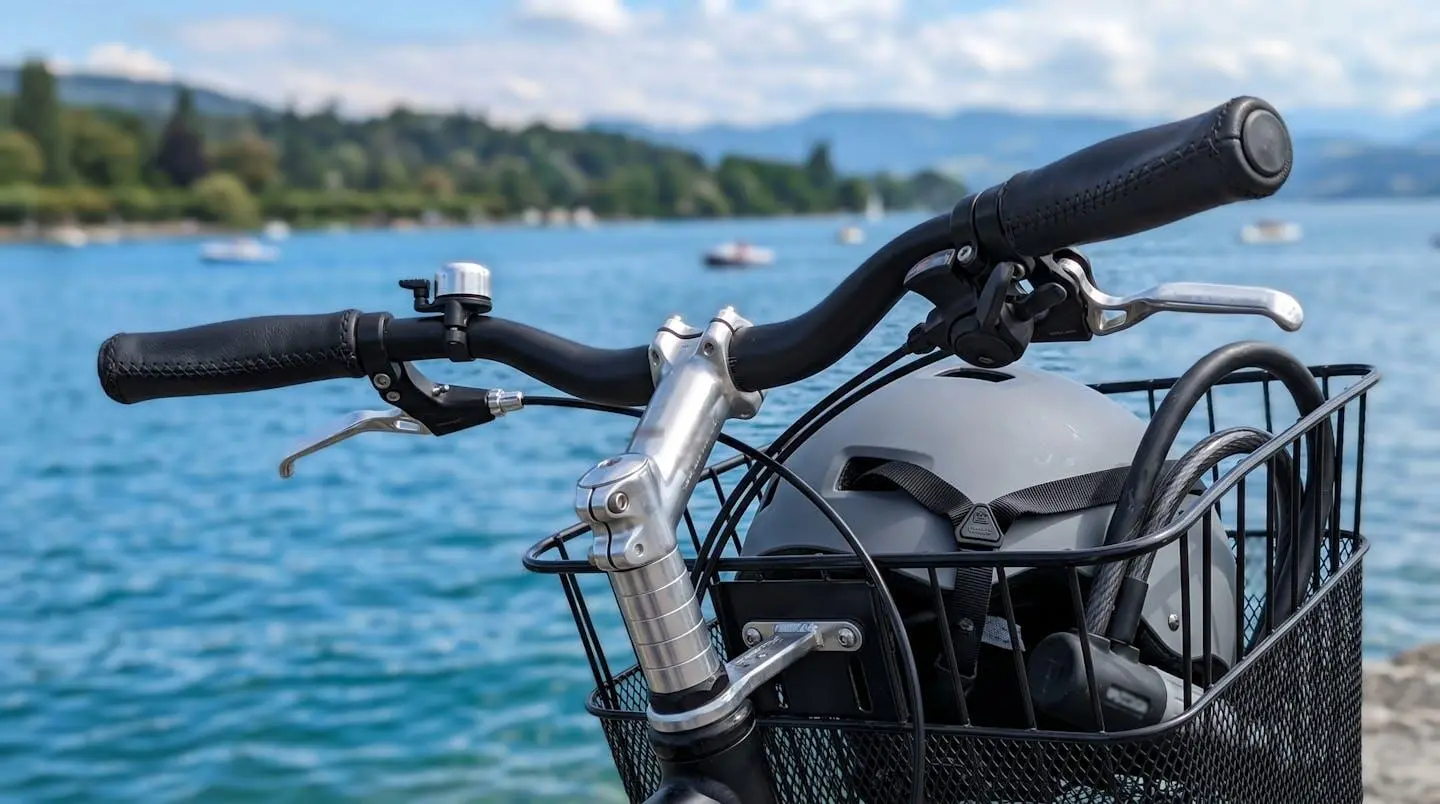
Booking timing influences availability more than most visitors anticipate. Peak summer weekends, particularly during July and August, see popular rental services exhaust their electric bike inventory by mid-morning. Advance reservations 48 hours ahead guarantee equipment availability and allow rental shops to prepare child-specific additions. The choice aligns with broader interest in eco-friendly bike rentals for travel, where quality providers maintain fleets specifically to reduce the environmental impact of lakeside tourism whilst ensuring reliable equipment for families.
Successful rides depend less on athletic ability than on methodical preparation addressing the specific challenges of lakeside cycling with mixed-ability groups. The following checklist covers decision points that distinguish smooth experiences from frustrating ones.
- Reserve bikes minimum 48 hours ahead during July-August to guarantee electric bike and child equipment availability
- Verify that helmets, locks, and baskets are included rather than charged separately
- Pack sun protection, refillable water bottles, and energy snacks even for short sections
- Download an offline map showing village locations and facilities before departure
- Establish a clear turn-back time with your group to avoid rushing the final leg under time pressure
- Identify rest stop villages in advance: Sévrier, Saint-Jorioz, Duingt, Talloires, and Doussard all offer facilities
- Save the rental shop contact number for emergency support or early return arrangements
Beyond the mechanical checklist items, one strategic decision multiplies enjoyment whilst minimizing friction with peak-season crowds. The timing of your departure determines not merely traffic volume but the entire character of the ride — early starts capture the lake in its most serene state, whilst late afternoon departures offer golden-hour light as most day-trippers return bikes. Both windows provide fundamentally different experiences from the midday rush when the greenway functions almost like a slow-moving cycling motorway.
Timing strategy: Launching before 9:00 provides two to three hours of quieter paths before peak crowds arrive, whilst starting after 16:00 captures the evening light when most day-trippers have returned bikes.
Your questions about cycling Lake Annecy with mixed abilities
Can a seven-year-old genuinely cycle 42km on their own bike?
With realistic pacing, many children aged eight and above complete the loop on their own bikes, though success requires five to six hours including frequent breaks, regular encouragement, and the flexibility to switch to a trailer if energy depletes. For seven-year-olds specifically, a trailer or tag-along attachment proves more reliable, with the option for independent cycling during flatter sections when enthusiasm runs high.
Will steep gradients defeat beginners or elderly riders?
The route remains predominantly flat, with the most noticeable climb near Talloires representing a gentle ascent entirely manageable on an electric bike and achievable for most riders on standard bikes equipped with low gears. The circuit avoids challenging Alpine climbs, keeping gradients within comfortable limits for recreational cyclists.
How safe is the route from motor traffic, particularly for children?
The majority of the loop follows dedicated, car-free greenway infrastructure. The remaining segments use quiet local roads shared with minimal vehicle traffic, primarily through village areas where speeds remain low. The infrastructure ranks among France’s safest family cycling routes, with underground passages eliminating the most hazardous road crossings.
What options exist if we tire halfway and cannot complete the circuit?
The circular route ensures you remain close to civilisation throughout. Multiple lakeside villages maintain bus connections back to Annecy, and many rental services arrange vehicle pickup for a fee. Alternatively, turning back creates an out-and-back route — the Annecy-to-Saint-Jorioz return journey makes a popular half-day option covering approximately 24 kilometres.
Must bikes be reserved in advance, or can we simply arrive and rent?
During peak season and summer weekends, advance booking is strongly recommended to guarantee availability of electric bikes, child trailers, and seats. For weekday visits outside peak periods, same-day rental usually remains feasible, though reserving 24 to 48 hours ahead provides certainty and allows shops to prepare your specific equipment requirements.
What transforms this route from marketing claim to genuine accessibility
- Purpose-built infrastructure with 3.5-metre-wide paved surfaces eliminates the technical skill barriers that defeat nervous cyclists on narrow paths
- Electric bike availability democratises access for seniors and less fit riders who would struggle on standard bikes
- Village spacing creates natural rest intervals every five to eight kilometres, preventing the cumulative fatigue that ruins longer rides
- Flexible distance options allow groups to complete satisfying rides without committing to the full 42-kilometre circuit